How to tell if you're watering your foundation enough
You can tell by measuring the soil on every side of the house, because the hose schedule and the yard surface do not show what the clay a foot down is doing. Enough water means each side stays close to its own usual moisture through a dry spell and no side ends up much drier than the others. A gap opening between the soil and the slab, or one side reading far below the rest, means that side needs more. A side that stays soggy for days means it is getting too much.
Updated November 8, 2026
Why watering the foundation matters on Texas clay
Clay swells when it gets wet and shrinks when it dries. In a long Texas dry spell the soil along the slab edge dries first, while the soil under the middle of the house stays moist because the slab shades it. The edge shrinks, pulls away and can let that part of the slab drop. That difference between the edge and the middle is what cracks drywall at door corners and makes doors stick.
Watering the foundation keeps the edge soil closer to the moisture under the middle of the house. The goal is even moisture all the way around. Soaking one side while another dries out is its own problem, because the house then rides on soil that is moving differently on each side.
What you can check by eye
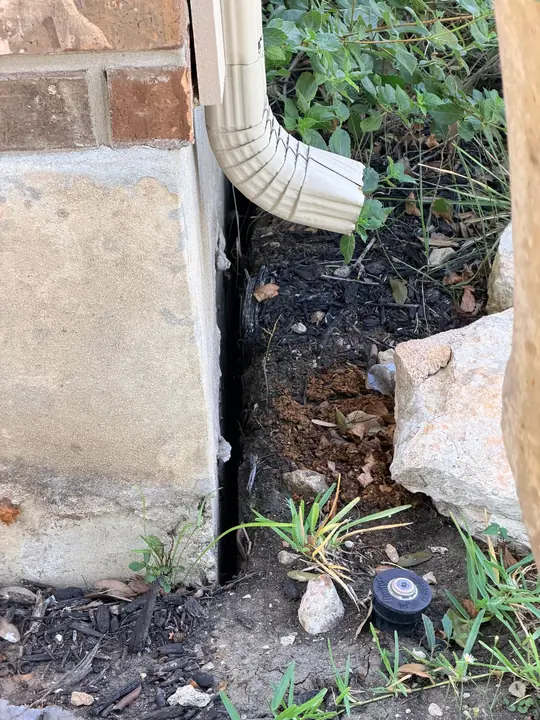
Walk around the house after a week without rain. Look for a gap between the soil and the slab edge, wide cracks in the ground near the house, and plants along one side wilting before the rest. Push a long screwdriver into the soil about a foot out from the slab on each side. If it goes in easily on three sides and stops hard on the fourth, the fourth side is drier.
These checks are free and worth doing. Their limit is that they show you the surface and a few inches below it, on the day you look. The clay that carries the slab edge sits deeper and changes slowly, so by the time a gap shows at the surface, the soil below has usually been drying for weeks.
How a soaker hose can still miss a side
A soaker hose for foundation watering rarely puts out water evenly. The end nearest the spigot often runs wetter than the far end, a kinked section gives almost nothing, and a hose that has drifted against the slab sends water straight down the edge. Shade, slope and a big tree on one side also change how fast each side dries. The same timer on a foundation watering system can leave the sunny west side short and the shaded north side wet.
For laying out the hose, how far from the slab to put it and how to set a timer, this guide to watering a foundation with a soaker hose covers it step by step. This page is about checking whether it is working.
Measuring the soil on every side
A soil moisture probe about a foot down reads the clay where it matters. MoisturePilot puts probes at the corners and along each side, plus one out in the open yard that never gets the hose. Each probe reports about every 70 seconds. The app compares every probe with its own usual level, which is the middle of its readings over the last three weeks with the newest three days left out.
That comparison answers the watering question. A side holding close to its usual level through a dry spell is getting enough. A spot reading well below its usual level is drying out, and the app marks it. When one side reads 18 points drier than another, the app shows an uneven moisture alert to watch, and at 28 points it says the gap needs attention. The yard probe shows what the weather alone did, so you can see how much difference your watering made.
Signs you are watering too much
More is not better on clay. Soil kept soggy swells and can lift the slab edge, and water pooled against the foundation can find its way under it. If a side stays well above its usual level for days and it has not rained, the hose on that side is running too long, a sprinkler zone overlaps it, or something else is adding water, such as a leak.
A probe that jumps 8 points or more in a day with almost no rain gets flagged in the app. If you just ran the hose on that side, that is the likely reason, and a shorter cycle fixes it. If you did not, treat it as a possible leak and have a plumber look. Our guide to slab leak signs covers what to check.
Using the readings to set the schedule
In the app you can ask a question about watering. It answers from your sensors and the rain records for your address, names any spot reading well below its usual level, and says when recent rain means you can skip a cycle. It does not run your timer, so you still make the change yourself.
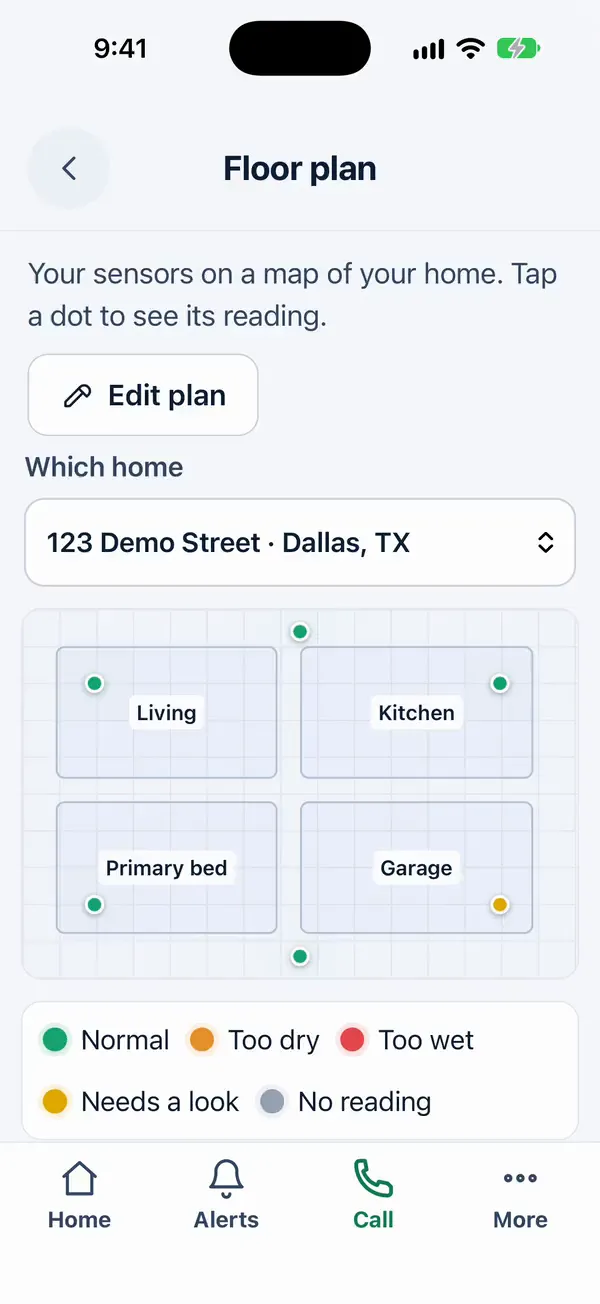
A simple routine works for most owners. Look at the floor plan once a week in summer. If one side is lagging, add time on that side only. If a side is staying wet, take time off. The floor plan replays the last 14 days, so after a change you can see whether that side moved back toward the others. Owners with big trees near the house have a harder job, and our page on homes with large trees explains why.
Questions people ask
How often should I water my foundation in Texas?
During dry spells, often enough that the soil stays evenly moist on every side. The usual setup is short regular cycles on a timer. The right amount depends on your soil, shade and slope, so the reliable answer comes from watching the soil on each side and adjusting that side.
Can you overwater a foundation?
Yes. Clay kept soggy swells and can lift the slab edge, and water pooled against the foundation can work its way under it. A side that stays well above its usual moisture for days without rain is getting too much.
How far from the foundation should a soaker hose be?
The usual advice is about 12 to 18 inches out from the slab, so the water soaks into the soil the slab edge rests on instead of running down the face of the foundation. Keep it on the soil, not against the concrete.
Does a foundation watering system mean I can stop checking?
No. A timer runs the same schedule on every side, but each side dries at its own pace. Checking the soil tells you which side is short and which is getting too much, so you can change only that side.
More guides
Plain answers about the soil around a house. See all guides.
Does a French drain work?
It works when it catches the water, carries it downhill and lets it out. Measuring the soil it protects shows whether it does.
WiFi soil moisture sensors for a foundation
They can, if the probes sit about a foot down around the whole house and each one is read against its own history.
Slab leak signs
A meter that moves with every tap closed, a warm spot on the floor, and soil that stays wet with no rain can all come first.
Register your property
Sensors are $60 each, paid once, a regular home needs 6 or more, and monitoring is $20 a month.