After foundation repairWatching the soil after your foundation is repaired
Piers carry the house down to firmer ground, but the clay around the slab still swells and shrinks with every wet and dry spell. A leak or a loose downspout can still push one side around. MoisturePilot reads that soil every day, so you hear about it while it is a small drainage or plumbing job.
Installed and monitored by our team in Texas.
What can still go wrong after the piers are in
The leak behind the repair
Many repairs begin with a leak under the slab. After the plumber fixes it, the probe over that line shows whether the soil dries back down or stays wet.
Drainage that was never corrected
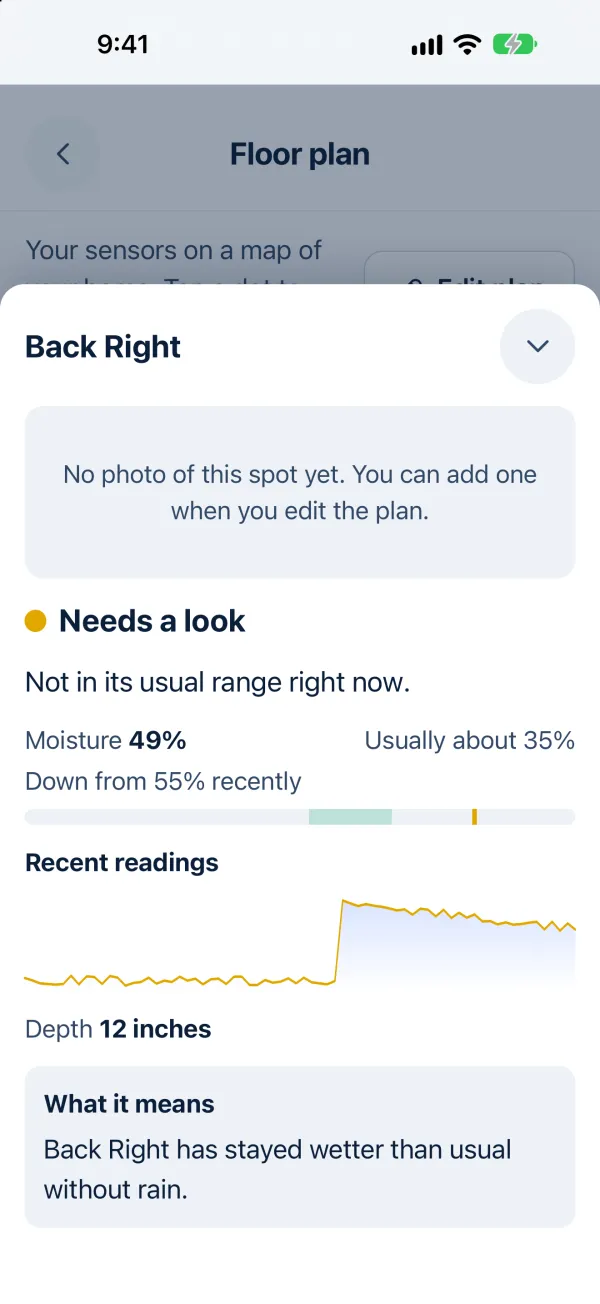
If the downspouts still end at the wall or the yard still slopes toward the house, the same corner keeps getting soaked. The app shows that corner staying wet after rain while the rest of the yard dries.
The part of the house without piers
A partial repair supports one section. The rest of the house still rides on the clay, so its sides are the ones to watch most closely.
A dated record for your warranty file
Repair warranties often ask the owner to keep up drainage and watering. The app saves every reading with its date, and the floor plan plays back the last two weeks, so you can show what the soil around the house has been doing.
The same probes show whether the soil around the house has gone back to steady readings. A zone that dries back down and stays steady through rain and dry spells is a good sign the water problem was fixed. If your repair came with a yearly follow up inspection, it still happens, and the sensors cover the days in between.
Questions from homeowners after a repair
Do I need to monitor my foundation after repair?
It is not required, but it is an inexpensive way to protect the work. Piers stop the repaired section from sinking further. They do not stop the clay around the house from swelling after a leak or shrinking in a drought, and that movement is what stresses the unrepaired parts of the house and the plumbing. Sensors tell you when the soil on one side starts behaving differently.
What does a foundation repair warranty cover?
Most pier warranties cover the repaired section against further settling, and many transfer to a new owner. Read the exclusions. Many leave out movement caused by plumbing leaks, poor drainage or soil left to dry out, which is why a dated soil record helps if a claim comes up.
Where do the sensors go after a pier repair?
At the corners, over the main plumbing lines, at any low spot or downspout, along the repaired section, and one out in the open yard as a control. A regular home needs at least 6, and 12 covers most repaired homes well.
When should I start watering after foundation repair?
Follow what your repair company tells you for the first weeks. After that, the usual Texas advice holds. Keep the soil evenly moist on every side through dry spells. Ask the app about watering and it names any spot reading well below its usual level, so you water where it is needed.
Guides on this topic
Foundation settling
Small, even settling in the first years is expected. Movement on one side that keeps growing needs a look.
Signs of foundation problems
Doors that start to stick, cracks that keep growing and floors that slope can all point to a house that is moving.
Other people who use MoisturePilot
Register your property
Sensors are $60 each, paid once, a regular home needs 6 or more, and monitoring is $20 a month.