Do wifi soil moisture sensors work for a foundation?
Yes, a wifi soil moisture sensor can watch the clay around a foundation, as long as it sits deep enough, goes around the whole house and is read against its own history. Most wireless soil moisture sensors are sold for gardens and lawns, so they are pushed in a few inches and judged against plant targets. Foundation soil needs probes about a foot down at the corners, near the plumbing and at low spots, plus one in the open yard to compare with the weather. The sensor gives you a number, and the software decides whether that number means anything for the house.
Updated November 8, 2026
How wireless soil moisture sensors work
Most wireless soil moisture sensors are capacitive. They measure how well the soil around the probe stores an electrical charge, which rises as the soil holds more water, and report it as a percent. The probe runs on a battery and sends its readings by radio to a small hub in the house. The hub is the part on your Wi-Fi. It passes the readings to an app.
So a wifi soil moisture sensor is usually a wireless probe plus a wifi hub. The probes do not need Wi-Fi out in the yard. They need to reach the hub.
What a foundation needs from the hardware
Depth comes first. The clay that carries a slab edge or a pier sits below the top few inches that dry out on a sunny afternoon, so the probes should sit about a foot down. They also need an outdoor rating for wet ground, a radio range long enough to reach the far corners of the lot from the hub, and a battery that lasts.
Count matters too. One probe in the flower bed tells you about one flower bed. A regular home needs at least 6 probes so every side, a plumbing zone and an open-yard control are covered. Twelve adds more plumbing zones, the drainage problem area and anything repaired before. The hub has to handle that many.
Why the raw percent can mislead
A capacitive reading depends on the soil as much as the water. Clay, sand, salts and how tightly the soil packs around the probe all shift the number, so two probes in the same yard can read differently in the same weather. A garden app that calls 30 percent dry and 50 percent wet is using bands meant for plants, and those bands do not tell you much about a slab.
The fix is to compare each probe with its own history. MoisturePilot sets each probe's usual level from the middle of its readings over the last three weeks, leaving out the newest three days. A change from that level carries meaning even when the raw number would not.
What garden apps leave out
A foundation needs a few things a garden app was never built to do. It needs to know whether rain explains a rise, so the app checks the rain records for your address and the open-yard probe. It needs to compare sides, so MoisturePilot shows an uneven moisture alert to watch when one side reads 18 points drier than another, and says it needs attention at 28.
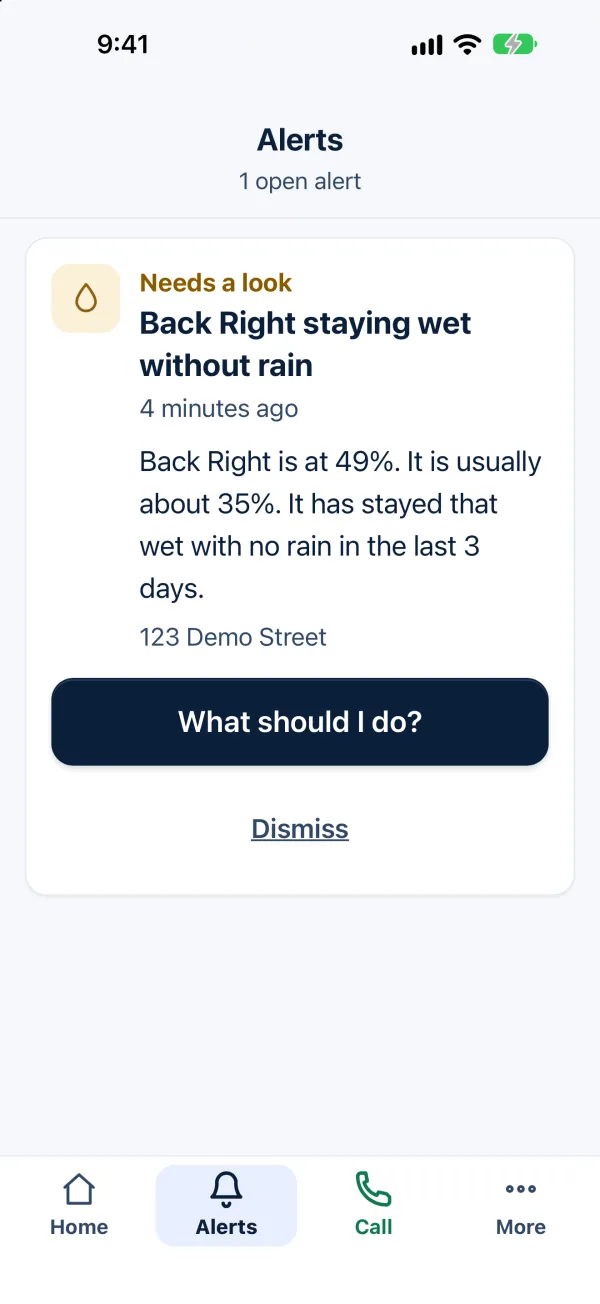
It also needs to know what is near each probe. A probe marked near plumbing that rises 8 points or more in a day with almost no rain is flagged as a possible leak. One near the AC drain or the ducts names those instead. Alerts say what changed and the sensible first call, and they show in the app. Phone notifications come with the iPhone and Android apps, which are on the way. Our guide to slab leak signs shows why that early rise matters.
When the Wi-Fi drops
If the hub loses its internet connection, readings from that stretch are missing from the app. After two days without a reading, the app says it has not heard from your sensors. Put the hub where the Wi-Fi is solid, or on Ethernet if you can. If you check on a house you do not live in, such as a vacant or second home or a parent's house, that missing-sensor notice is worth knowing about.
What MoisturePilot uses
The probes are wireless capacitive sensors that read moisture, temperature and electrical conductivity about every 70 seconds. They are rated for outdoor use, run on one AA battery and reach a hub up to about 100 meters away. The hub connects over Wi-Fi or Ethernet, takes up to 16 probes and keeps a backup copy on a memory card.
Sensors cost $60 each, paid once, and a regular home needs at least 6. Monitoring is $20 a month. The hub's price will be published before ordering opens. In our Texas service area the probes can be installed for you, or you can place them yourself.
Questions people ask
How deep should a soil moisture sensor be for a foundation?
About a foot down. The top few inches dry out fast in the sun and say little about the clay that carries the slab edge or the piers. A probe a foot down reads the soil that moves the house.
Do wireless soil moisture sensors need Wi-Fi?
The probes usually send their readings by radio to a hub inside the house, and the hub connects to Wi-Fi or Ethernet. The probes in the yard do not need Wi-Fi themselves, but they need to be within range of the hub.
How many soil moisture sensors does a house need?
A regular home needs at least 6, so every side, a plumbing zone and one open-yard control are covered. Twelve adds more plumbing zones, the drainage problem area and anything repaired before, and larger homes may need more.
Can I use a garden soil moisture sensor for my foundation?
You can read the soil with one, but garden sensors are usually set a few inches deep and judged against plant targets. For a foundation, the probes should sit about a foot down around the whole house and be compared with their own usual levels and with each other.
More guides
Plain answers about the soil around a house. See all guides.
Is your foundation watering enough?
The hose schedule and the yard surface do not show what the clay a foot down is doing. Measuring each side does.
Slab leak signs
A meter that moves with every tap closed, a warm spot on the floor, and soil that stays wet with no rain can all come first.
Normal crawl space moisture
Air humidity, wood moisture and soil moisture are three different numbers. For the soil, your own usual level is the one to watch.
Register your property
Sensors are $60 each, paid once, a regular home needs 6 or more, and monitoring is $20 a month.