For foundation repair companiesMonitoring for foundation repair companies
We built MoisturePilot around how foundation repair crews work. After the piers go in, the soil around the house keeps moving, and the call that comes two years later is usually about water. Monitoring shows the water problem while it is still a drainage or plumbing call.
Installed and monitored by our team in Texas.
What a repair company gets
A staff view of your customers
Every monitored property with its sensors and open alerts, plus leads, inspection requests, invoices and documents.
A record for the warranty
Readings by date around every repaired house, so a warranty question starts from what the soil actually did.
Homeowners who follow along
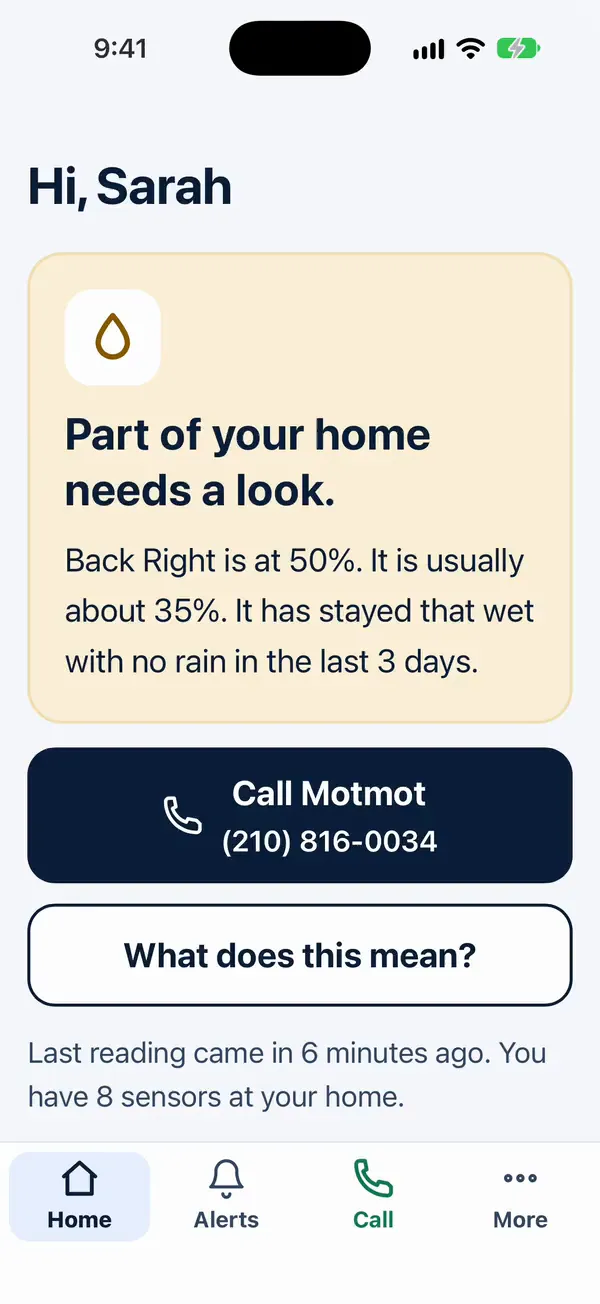
Customers read plain sentences about their own house, which makes the drainage conversation shorter.
Running it for your own customers
Company accounts are arranged directly. Tell us how many properties you would monitor, where you work and how you handle warranties.
Today the homeowner app carries our own branding, and its Call button dials our own repair team, not yours. Tell us how your customers should reach you when you write.
Questions from foundation repair companies
Why should a foundation repair company offer monitoring?
Most problems after a repair come from water, such as a leak, a downspout or a dry side in summer. Watching the soil lets you catch that while it is a drainage call, and the record helps when a warranty question comes up.
What do homeowners pay for MoisturePilot?
Sensors are $60 each, paid once, and a regular home needs at least 6. Monitoring is $20 a month. Pricing for company accounts is arranged directly.
Which sensors does MoisturePilot use?
Wireless capacitive soil probes that sit about a foot down and report to a small hub on the home's Wi-Fi roughly every 70 seconds. If the internet drops, readings from that stretch are missing from the record.
Guides on this topic
Foundation settling
Small, even settling in the first years is expected. Movement on one side that keeps growing needs a look.
Signs of foundation problems
Doors that start to stick, cracks that keep growing and floors that slope can all point to a house that is moving.
Foundation inspection
A walk around the outside, a walk through the inside and a floor level survey, written up as a report or a repair plan.
Other people who use MoisturePilot
Register your property
Sensors are $60 each, paid once, a regular home needs 6 or more, and monitoring is $20 a month.