For home inspectorsSoil moisture history for home inspections
You see the house on one day. You can note a crack, a sticking door or a downspout dumping against the slab, but you cannot see what the soil did before you arrived. When the owner has sensors in the ground, the last two weeks are there to read.
Installed and monitored by our team in Texas.
How it fits an inspection
Read it as background
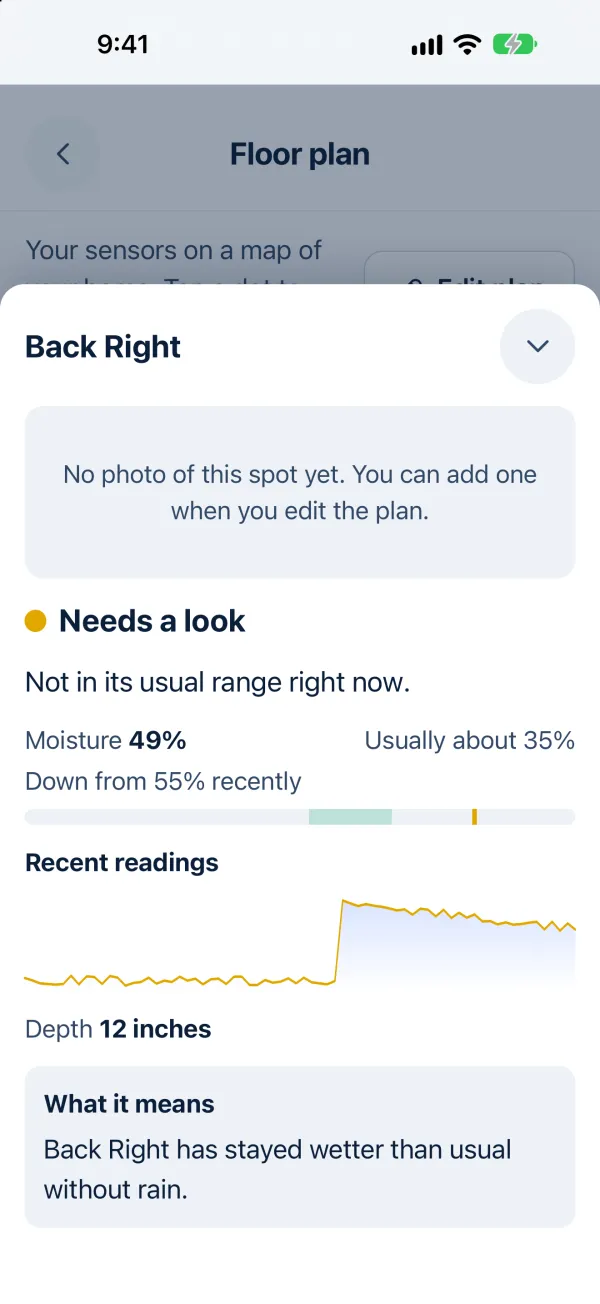
The readings show which side has been wetter or drier than its usual level, and when. That can point your attention to a corner before you walk it.
Keep it apart from your findings
The data reports soil moisture only. It is not a level survey and says nothing about structural condition, which stays your call or the engineer's.
Recommend it when you find a cause
When your report notes poor drainage or a likely plumbing issue, monitoring is how the buyer finds out whether the fix worked.
What a shared record contains
Every sensor's recent readings and its usual level, any open alerts with what they suggest, and documents the owner attached, such as a repair report.
The owner shares the property with your mobile number from the app, and you open it on your phone or computer during the inspection.
Questions from home inspectors
How do home inspectors check a foundation?
They look for signs. Cracks in the slab, brick and drywall, sloping floors, doors and windows that stick, gaps at frames, and drainage that sends water toward the house. Some measure floor elevation. Where the signs are significant, they refer the buyer to a structural engineer.
Do home inspectors use a moisture meter?
Many do. A pin or pinless meter reads moisture in drywall, flooring and trim on the day of the inspection, which helps find leaks around showers, windows and plumbing walls. It reads the material it touches. The soil under and around the slab needs probes in the ground, and those keep reading after the inspection is over.
Can soil moisture readings replace an elevation survey?
No. Soil moisture shows what the ground is doing, and an elevation survey shows where the foundation is. They answer different questions and work best together.
How often do the soil sensors take readings?
Each probe reports roughly every 70 seconds. Its usual level comes from its own readings over the last three weeks. Readings keep their timestamps and are shown separately from any interpretation.
Guides on this topic
Signs of foundation problems
Doors that start to stick, cracks that keep growing and floors that slope can all point to a house that is moving.
Foundation settling
Small, even settling in the first years is expected. Movement on one side that keeps growing needs a look.
Foundation cracks
Thin, even cracks are common. Wide cracks, offset edges and cracks that keep growing are the ones to watch.
Foundation inspection
A walk around the outside, a walk through the inside and a floor level survey, written up as a report or a repair plan.
Other people who use MoisturePilot
Register your property
Sensors are $60 each, paid once, a regular home needs 6 or more, and monitoring is $20 a month.