For structural engineersSoil data for structural engineer foundation inspections
An elevation survey tells you where the slab is today. It does not tell you what the soil did to put it there, or whether it is still doing it. Readings from probes around the perimeter, beside a probe in the open yard, fill in part of that.
Installed and monitored by our team in Texas.
What the data includes
Readings by date
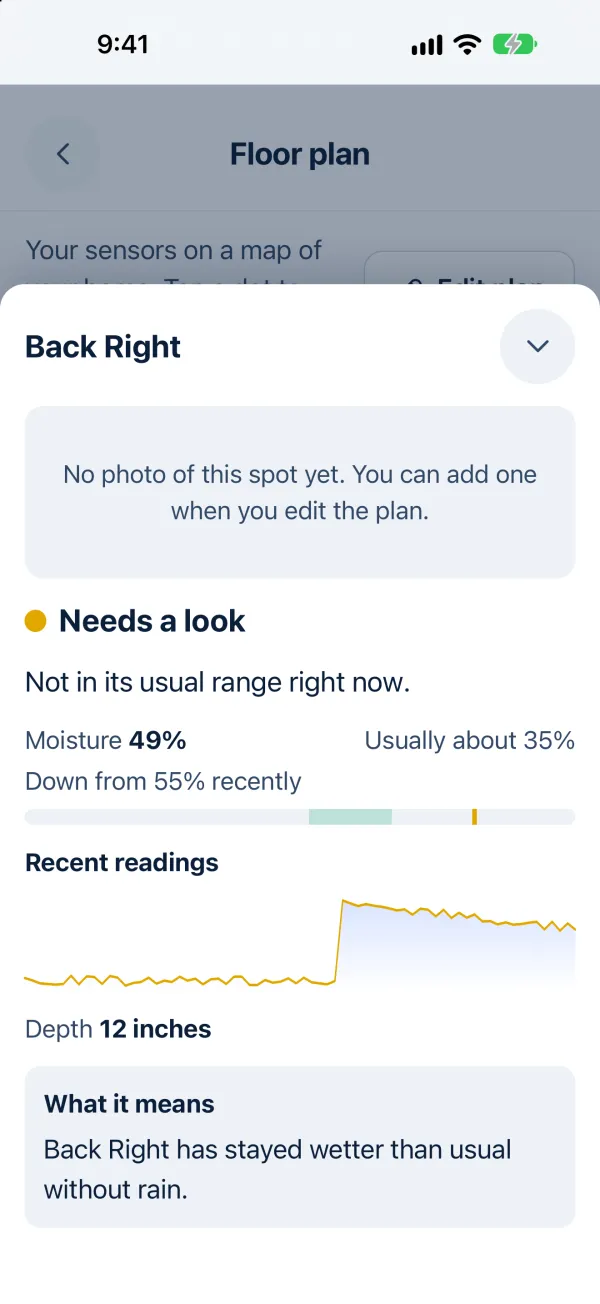
Moisture readings per probe with timestamps, roughly every 70 seconds. The app shows recent readings and two weeks of status on the floor plan.
A usual level per probe
Each probe's usual level is the median of its own readings over the last three weeks, so a departure is measured against that spot. Alerts start at set distances from that level, such as 10 points above it.
A probe in the open yard
At least one probe sits in the open yard away from the house, and its readings sit beside the slab probes for comparison. The app's own analysis uses the rain records for the address.
How the app keeps readings apart from its interpretation
The app's interpretation is labeled as interpretation, in words like possible and likely. The readings underneath are shown as measured.
Owners share the property with your mobile number from the app. You see each probe's recent readings, the last two weeks of status on the floor plan, and any repair documents attached to the house.
Questions from structural engineers
What does a structural engineer foundation inspection include?
Usually a walk through the house and around the outside, a floor elevation survey, a look at cracks, doors and windows, and a review of the drainage, trees and plumbing near the slab. The engineer then writes a report on whether the foundation has moved, the likely cause and whether repair is needed. When the owner has sensors, the readings add how the soil has behaved over the last two weeks.
How accurate are capacitive soil moisture sensors?
They are best at showing change at one spot over time. Absolute values depend on soil type and how well the probe contacts the soil, which is why MoisturePilot judges each probe against its own recent readings.
Can soil moisture data explain foundation movement?
It can show the moisture conditions that usually drive movement on expansive clay, such as one side staying wet or drying faster than the rest. It does not measure movement, so pair it with elevation readings.
Where are the soil probes placed?
About a foot down at the corners, over the main plumbing runs, at low spots and downspouts, at previously repaired areas, and at least one in the open yard as a control.
Guides on this topic
Foundation settling
Small, even settling in the first years is expected. Movement on one side that keeps growing needs a look.
Signs of foundation problems
Doors that start to stick, cracks that keep growing and floors that slope can all point to a house that is moving.
Foundation cracks
Thin, even cracks are common. Wide cracks, offset edges and cracks that keep growing are the ones to watch.
Foundation inspection
A walk around the outside, a walk through the inside and a floor level survey, written up as a report or a repair plan.
Other people who use MoisturePilot
Register your property
Sensors are $60 each, paid once, a regular home needs 6 or more, and monitoring is $20 a month.